
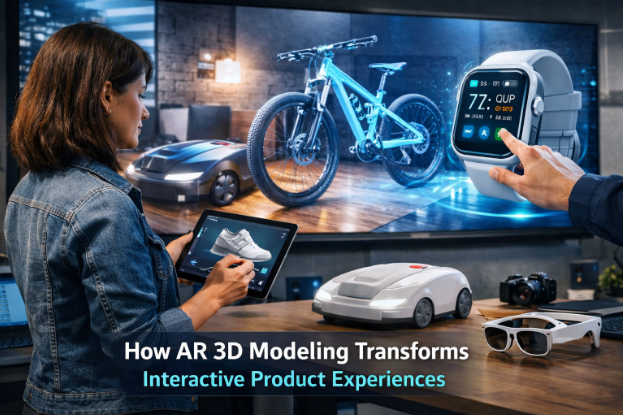

Today, due to rapid changes taking place within the online world of shopping, brands have had no choice but to rethink and reinvent the ways and means by which they showcase products and interact with consumers.
Consumers today want more than mere information and product knowledge; they crave experiences that are more immersive and interactive and have a life-like appeal. This has made AR 3D modeling stand at the forefront of today’s product interactions. AR combines these with very detailed and realistic 3D product models.
Specifically, these experiences rely on the expertise of a professional 3D modeling company capable of creating highly precise and high-quality digital models that are optimal for AR. AR and highly advanced 3D models are revolutionizing the manner in which customers engage with products on a viewing and emotive level.
Below is an in-depth examination of the paradigm shift in interactive product experience influenced by AR 3D modeling.
1. Product Entry into Real-World Environments with Actual-Size Placements
It would be difficult to list all challenges surrounding online shopping, but customers might be unsure about a product’s functionality, whether it will fit into a specific space and match home decor, and if it will fit with an intended lifestyle. Solutions include 3D modeling and AR.
It clears immediate misunderstandings about:
- Size, proportions
- Style compatibility
- Functional placement
- Aesthetic appeal in context
Seeing a product ‘alive’ in their own environment will greatly improve confidence levels with regard to decision-making.
2. Enabling Immersive 360° Product Viewing
Although classic product images have very limited interactivity, AR completely empowers customers with control, as they can rotate, zoom, and walk around an object as if it were physically present.
This freedom of interactions enables consumers to browse:
- Material textures
- Design Details
- Structural members
- Artisanry quality
The reason for it is that a good model created by a 3D modeling firm should impart a realistic and smooth, trustworthy feel to the experience.
3. Highlighting Features with Realistic AR Animations
Certain products need to be viewed more effectively with features and functions shown as they would be used. AR functionality allows brands to showcase these functions as they relate to product usage. It isn’t easy to do so with still images.
Customers can access:
- How a recliner chair opens
- Junctions of furniture components
- Functions/operation of appliance components
- Storage unit expanding/ folding
All these demos make it easy to grasp the complex feature, thus making it more attractive and clearer.
4. Achieving Real-Time Personalization for Personalized Engagement
It is because of this that customization is becoming an increasingly important buying factor. Using AR 3D modeling, customers can immediately customize a product with a simple tap on the screen.
It enables consumers to compare:
- Options for materials and textures
- Color Combinations
- Component Variations
- Functional add-ons
All these customizations, very realistically viewed with the help of a professional 3D modeling firm, assist the buyer in selecting the best options that fit their own preferences.
5. Reducing Uncertainty and Boosting Confidence Regarding Purchase
Immersive AR experiences eliminate any doubts that, as a rule, arise while buying online. The customer understands clearly:
- How big the product truly is
- Its perspective as viewed from all sides
- Whether it suits the environment
- How its features actually work
It leads to rapid decision-making, fewer queries, and return rates that are significantly lower.
6. Creating Affective Bonding Through Immersive Engagement
It leads to an attachment or bonding. The capacity for customers to visualize the product either in their own surroundings or through touch develops an ownership sense before they have even made a purchase.
This type of emotional involvement may result in:
- Increased interaction time with the product
- Increased desire to buy
- Increased brand recognition
- Increased overall satisfaction
AR changes an electronic commerce transaction into an experience filled with memories.
7. Enable Better Product Education and User Understanding
Moreover, beyond mere pre-purchase analysis and exploration, AR enhances customer understanding about usage, unboxing, and maintenance procedures because it uses visual overlays.
Examples include:
- Assembly manuals with step-by-step procedures
- Maintenance tutorials
- Walk-throughs of features
These tools make it easier for people and reduce frustrations.
8. Offering a Competitive Advantage in a Niche Market
Because there’s so much saturation in online businesses, it becomes absolutely necessary for brands to have a creative approach towards standing out. AR-based experiences for products showcase a sense of technological sophistication and customer focus.
Brands that open up to AR reap these benefits:
- Higher conversion rates
- Increased interactivity
- Increased customer loyalty
It sets them apart as leaders in offering an interactive and modern shopping experience.
Conclusion
AR 3D modeling represents a paradigm shift within customer-product interactions on the internet, as it enables customers to have an experience with products that mimics as closely as possible interactions with the product as if it were physical. By using high-quality assets from an experienced 3D modeling company, AR can be an extremely useful platform for reducing uncertainty and assisting with decision-making.
As online commerce continues to evolve and define itself within the next generation, brands with the inclusion of AR within their product experience strategy will have a better chance at reaching and connecting with more people and setting a new standard in interactive commerce within today’s current global market.